Local SEO for cleaners, pest control and mobile services

A cleaning company, a pest controller or a mobile dog groomer goes to its customers, and Google's guidelines say what follows from that: if customers aren't served at your address, hide it and list the areas you cover instead. What the list can't do is put you in front of customers in every town on it. SearchOps scans Google from any town you serve, checks your profile against Google's service-area rules, tracks who ChatGPT and Gemini suggest in your towns, and keeps your address out of every report you share.

  • A map scan centred on any town you serve
  • Your profile checked against Google's service-area rules
  • ChatGPT and Gemini prompts that name your towns
  • Your address kept out of every report you share

The problem

A hidden address, a list of towns, and a different contest in each one

Google's guidelines are specific about a business that travels to its customers. If customers aren't served at your address, hide it. Run one profile from your base, not one for each town. List up to 20 service areas, and keep the overall area within about 2 hours' drive of where the business is based. Following the rules doesn't put you in front of customers in every town on the list, though. Google names distance as one of the three things behind its local results, alongside relevance and prominence, and hiding an address doesn't change where the business is based. The town next to your base and the town an hour away can be two very different contests.

01

Recurring work, such as a fortnightly clean or a window round, repeats once it's won. One-off jobs, such as an end-of-tenancy clean, a wasp nest or a pre-sale valet, have to be won each time, and each can bring a different set of rivals on the map.

02

With no premises to photograph, the profile has to show the business through its work: finished jobs, the team and the van.

03

Trade platforms and directories carry listings of their own, and AI answers can cite them when someone asks who to book.

04

When the base is a home address, every report and map you share has to leave it out.

Questions SearchOps answers

Five questions for a business that comes to the customer

Each question points to a different next move: push into a town, fix the profile, add a listing or write a page. All five are answered from the towns you serve, not from an address your customers never see.

01Reach

Which of our towns do we actually show up in?

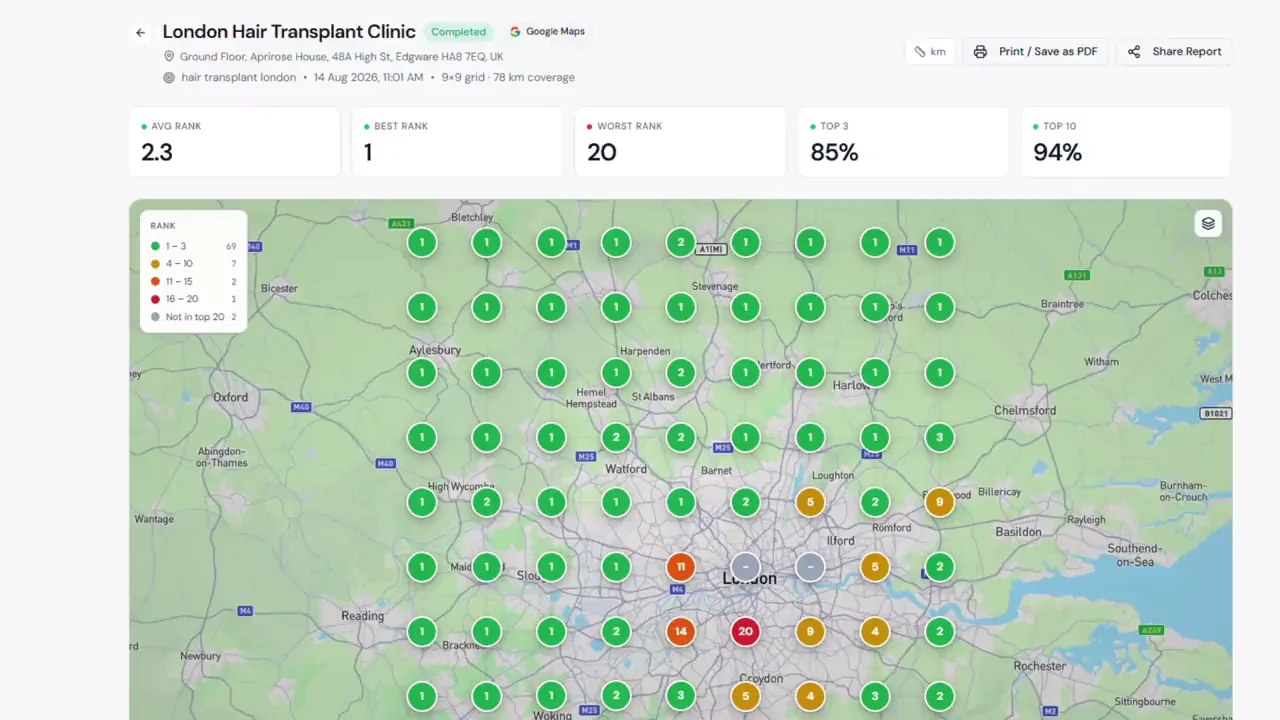
Centre a geo-grid scan on any town you serve, or run one grid over the whole service area to see where your reach fades. Your towns come from your Google profile or you type them in, and SearchOps places them on the map for you. Each town is its own scan and uses credits like any other, and the location's overview lists every town with your strongest and weakest keyword there.

The towns you win, and the ones you only drive to
02Rules

Does our profile follow Google's service-area rules?

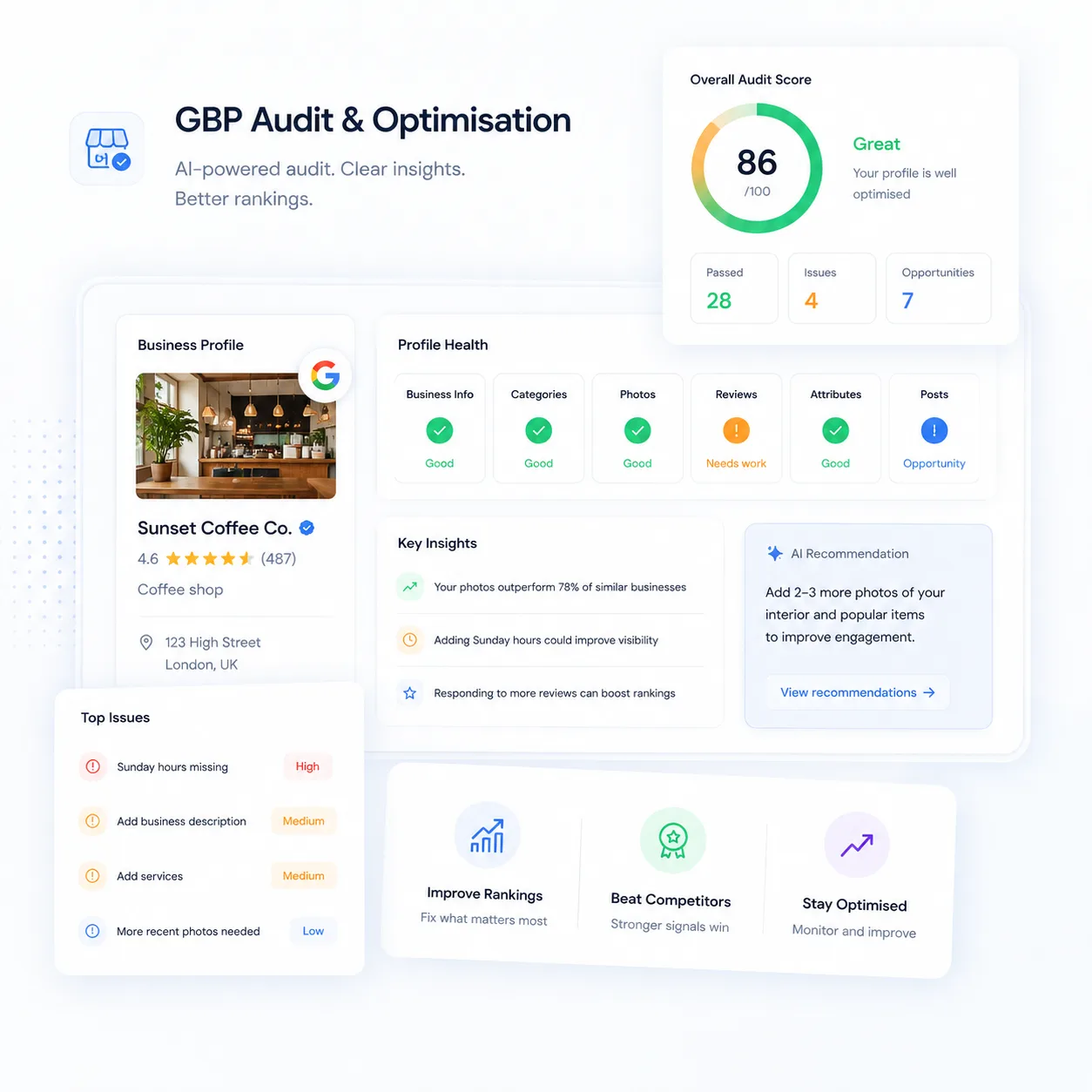
The GBP audit checks what Google's guidelines ask of a business that travels: an address on show where customers aren't served, and service areas that are missing, too broad (a whole state or country), or more than about 2 hours' drive from where Google places you. It asks for photos of finished jobs and the team rather than premises, and reads your opening hours as the hours you take calls and bookings.

A profile set up the way Google expects for a business with no premises

03Jobs

Do we show up for each job, in each town?

Keyword setup offers each main service in each town you serve, such as 'oven cleaning Harrogate' or 'wasp nest removal Leeds'. Track the one-off jobs you want more of beside your core service. Scheduled scans, daily to monthly, show whether your visibility holds through the year, which matters if your work is seasonal.

Visibility for every job you want more of, in every town you cover

04AI answers

Who do ChatGPT and Gemini suggest in our towns?

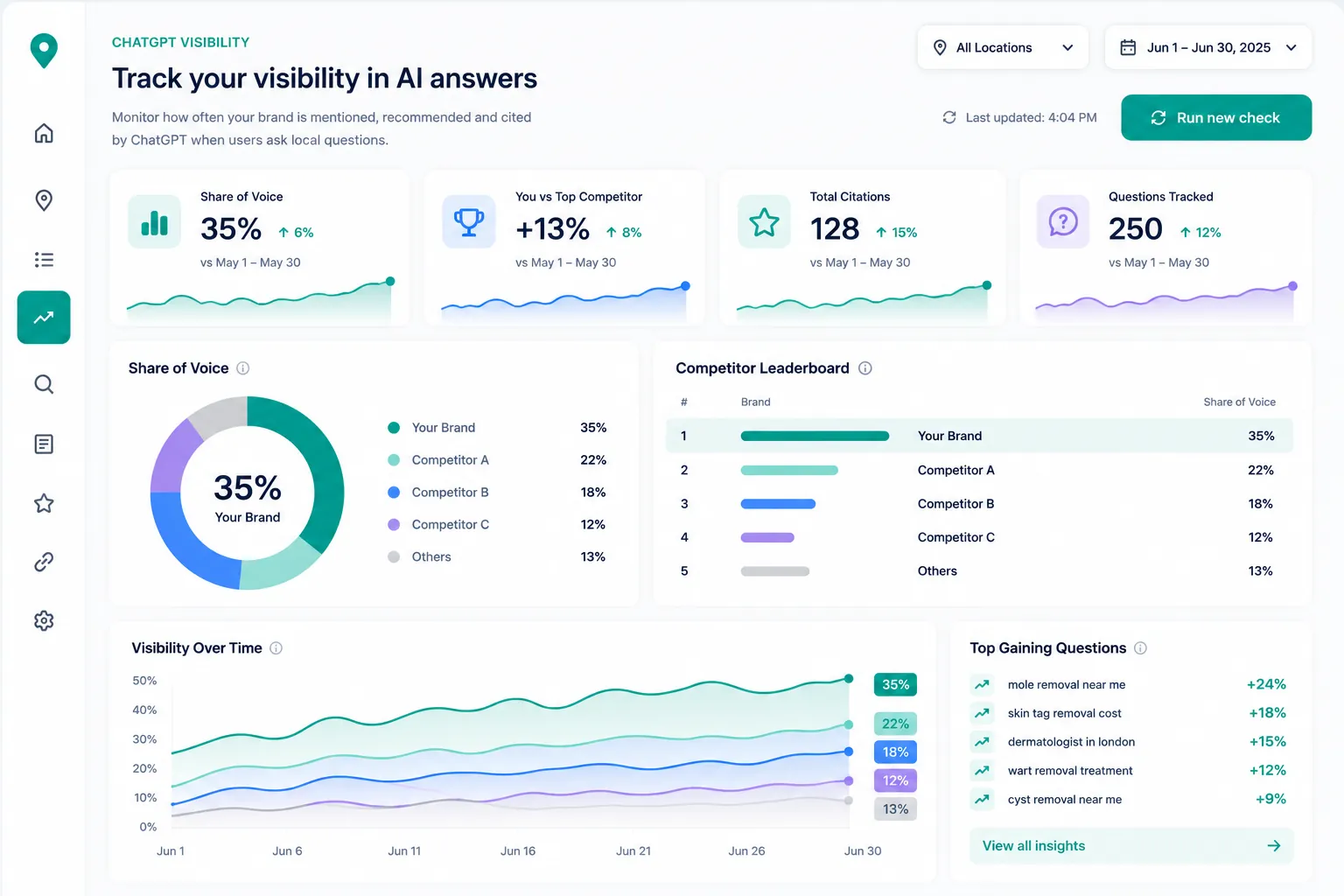
LLM Visibility puts the questions customers ask to ChatGPT and Gemini on a schedule, and a prompt names one of your towns when the keyword it comes from does. You see how often you're named, who is named instead, and the sites the answers cite, including trade platforms and directories.

Your share of AI recommendations in the towns you cover

05Listings

Are we listed where customers check, without giving our address away?

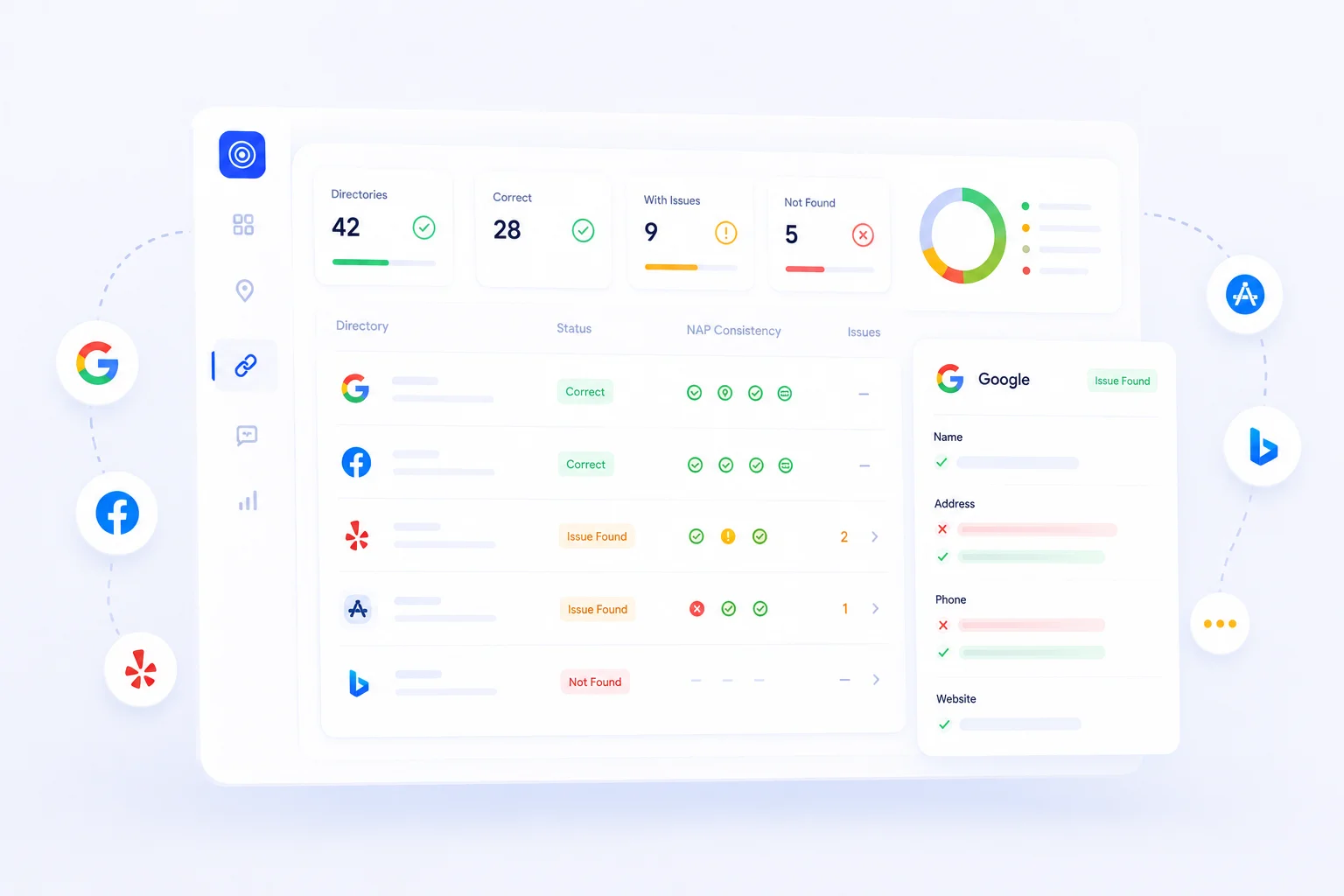
Citations & Links checks your listings on the directories for your country and trade, trade platforms included, and recognises your own listings by your phone, website and towns rather than a postcode. It marks the sites that always show a street address and reminds you to hide yours where a site allows it. Tasks ask you to list your towns if none are set, and the agent's plan can suggest a page for a town your website doesn't cover yet.

Listings that match, an address that stays private, and the next job to do

Before and after

From a list of towns to a map of where you win

Knowing your reach
Without the dataAssuming you show up in every town on your profile
With SearchOpsA scan centred on any town you serve, or one grid across them all
Google's service-area rules
Without the dataAn address still on show from the day the profile was set up
With SearchOpsThe audit flags an address that should be hidden, and service areas that are missing, too broad or too far
One-off jobs
Without the dataSearching 'oven cleaning near me' from your own driveway
With SearchOpsEach job tracked in each town, on a schedule you choose
AI recommendations
Without the dataNo idea who ChatGPT suggests when someone asks for a cleaner
With SearchOpsHow often ChatGPT and Gemini name you for prompts about your towns, and who they name instead
Directory listings
Without the dataListings you can't match without a postcode, and an address you meant to keep private
With SearchOpsYour listings recognised by phone, website and towns, and the sites that always show an address marked
Sharing results
Without the dataScreenshots that show where you live
With SearchOpsShared reports that never show your address

Use cases

Questions mobile businesses bring to the data

Illustrative examples, not real customers: the kind of question a cleaning or mobile service business asks, and the kind of answer the data gives. Your own scans will tell your own story.

Domestic cleaning company, three teamsLeeds, UK

“Our profile lists eight towns. Which ones do we really show up in?”

Scans centred on each town for 'house cleaner' and 'end of tenancy cleaning' show the company in the top three in the two towns nearest its base and outside the top ten in the three furthest out. Distance counts from where the business is based, so the owner can choose between building reviews and a page for each far town or putting the effort where the teams already win.

Pest control firmPerth, Australia

“If termite work picks up in the warmer months, are we visible when it does?”

Weekly scans for 'termite inspection' and 'pest control', centred on the suburbs the firm serves, show where it sits through the year. Where it slips behind a rival, Geo-Grid Insights compares the two profiles on categories, reviews and listing details, so the firm can see what the rival has that it doesn't.

Mobile dog groomerAuckland, New Zealand

“When someone asks ChatGPT for a mobile dog groomer on the North Shore, are we named?”

Prompts that name the suburbs the groomer serves show the business named in some answers and a salon-based groomer named in most. The answers cite a pet services directory where the groomer has no listing, which gives the owner a specific place to start.

Window cleaning roundCork, Ireland

“Our home address is showing on Google. Does it matter?”

The GBP audit flags an address on show for a business that doesn't serve customers there, which Google's guidelines ask you to hide, and checks the service areas listed in its place. Once the address is hidden, the owner can share reports with no address in them.

Mobile car detailing businessCalgary, Canada

“We drive to customers across the city. Where does our reach run out?”

A one-off scan over the whole service area for 'mobile car detailing' shows the business strong in the south of the city and absent in the north, where two rivals with more recent reviews hold the map. Scans centred on the northern suburbs then show whether new reviews and photos of finished cars close the gap.

Commercial cleaning contractorDenver, US

“Are we listed on the sites AI answers rely on?”

AI Citations shows which sites ChatGPT and Gemini cite when asked about office cleaning in the city, and Citations & Links checks the contractor's listings on the directories and trade platforms for its country. A site the answers cite often, where the contractor has no listing, is the next one to add.

Choosing a plan

The right plan for one van or a whole network

Every plan includes every tracking tool. A business that serves many towns is still one location on your plan. What grows with the number of towns is the scans you run, because each town is its own scan and uses scan credits.

Compare every plan

Starter

For an owner-operator or a single team

  • 10 tracked locations, including rivals you want to watch
  • 1 connected Google profile
  • 4,500 scan credits a month: a 7×7 Google Maps scan of one town uses 49
  • Map scans up to 15×15

Pro

For a firm with several teams covering many towns

  • 50 tracked locations
  • 25 connected Google profiles
  • 12,000 scan credits a month, and map scans up to 21×21
  • Automatic replies to 4 and 5 star Google reviews

Agency

For franchise networks and the agencies that market them

  • 200 tracked locations
  • 100 connected Google profiles
  • White-label client reports
  • Unlimited team members

FAQ

Cleaners and mobile services. Questions we get

Yes, if customers aren't served there. Google's guidelines ask a business that travels to its customers to hide its address and set the areas it serves, and give the example of a plumber who runs the business from home. A business with premises customers visit, such as a grooming salon that also sends out a van, can show its address and add a service area as well. In SearchOps the GBP audit flags an address on show that should be hidden, and the reports you share never show it.

Google lets you set up to 20 service areas, by city, postcode or area, and asks that the overall area stays within about 2 hours' driving time of where the business is based, though it says larger areas suit some businesses. SearchOps takes up to 20 towns for each location and places them on the map for you. A town more than about 2 hours' drive from where Google places your listing isn't placed, and a whole county or state stays on your list but is never used as the centre of a scan.

Google names relevance, distance and prominence as the main factors in its local results. Hiding your address doesn't change where you're based, so towns further from your base can be harder to win than the ones nearby. A scan centred on each town shows where that happens, and Geo-Grid Insights compares you with the businesses that win there on categories, reviews and listing details, so you can tell a gap you can close from one that comes down to distance.

The one that describes the main job: 'House cleaning service' for domestic cleaning, 'Carpet cleaning service' or 'Window cleaning service' for those trades, 'Pest control service' for pest control and 'Pet groomer' for dog grooming. Car valeting is one category with two names: 'Valeting service' in the UK and 'Car detailing service' in the US. Names can vary by country, so pick from the list your profile offers, and add secondary categories only for work you really do.

Yes. Each town is its own scan and uses credits like any other: a Google Maps scan uses one credit per point on the grid, so a 7×7 scan of one town uses 49. Scans of your towns are only ever started by you or by a campaign you set up. If you stop serving a town, a scheduled campaign centred on it is skipped rather than charged, and we email you so you can add the town back or move the campaign.

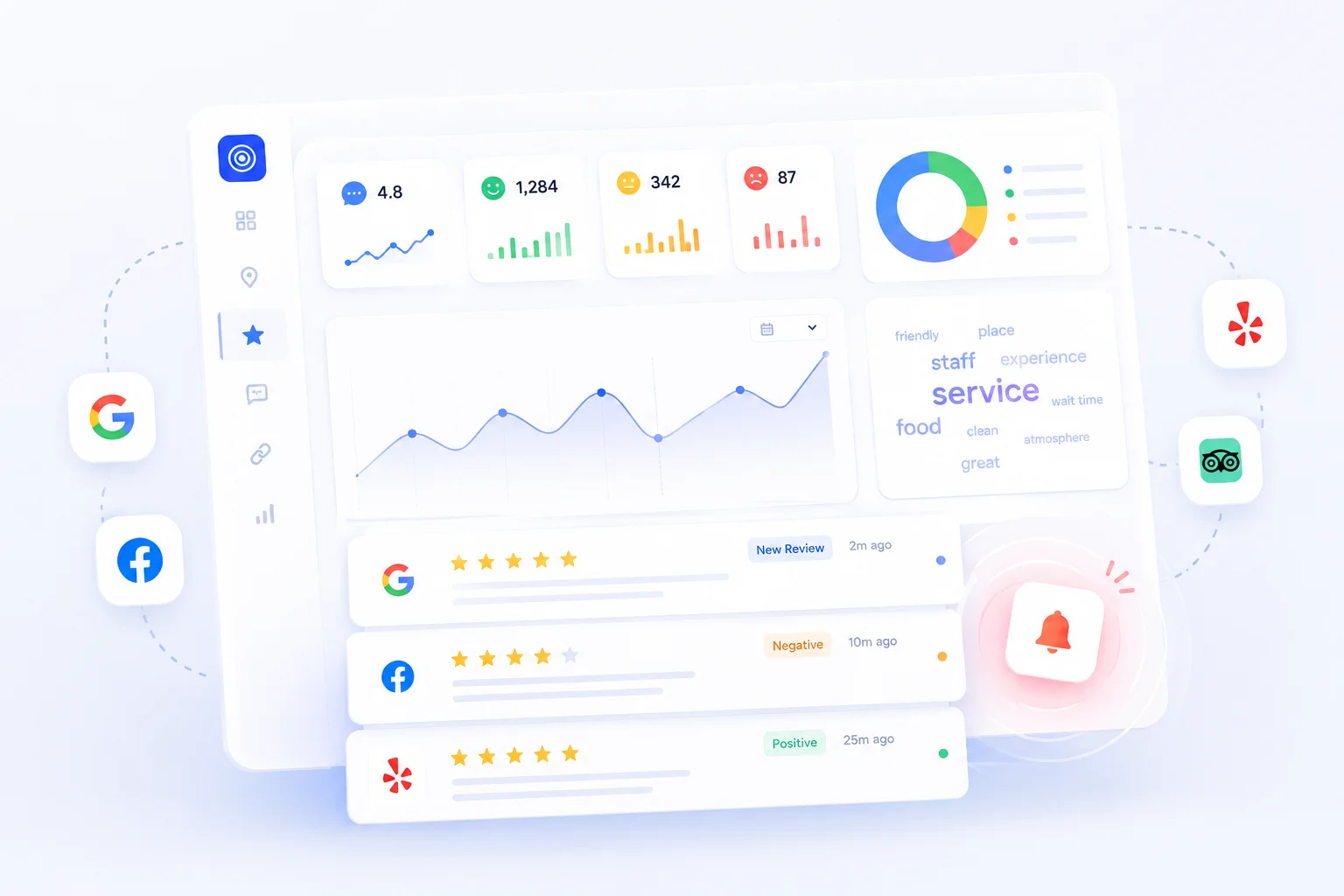
Ask every customer the same way once the job is done, for example with a link in the follow-up text or email, and let them write what they like. You can invite them to describe the job in their own words. Google's policy bars asking for specific content, so don't ask them to name the cleaner or groomer, or to mention a particular service. On a connected Google profile, the agent drafts a reply to each new review for you to edit and send.

Photos of the work and the people who do it: finished jobs, before-and-after shots taken with the customer's permission, the team and the van. Google describes photos as a way to show customers what you offer, and for a business customers never visit, the work is what there is to show. The GBP audit asks a service-area business for photos of finished jobs and the team rather than premises.

Start tracking your real rankings today

See where you actually rank on Google Maps, not where Google tells you. Pick the plan that fits and start tracking from day one.